The enhancement of historical and artistic heritage increasingly relies on collaboration between companies and university research centers, where new digital approaches to study and access can emerge.
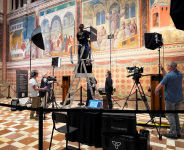
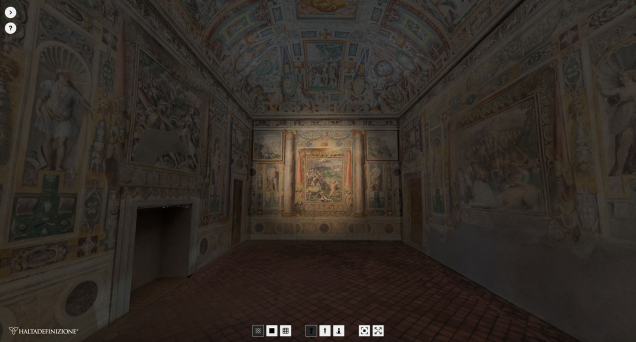
Within this framework lies the partnership between Haltadefinizione and the University of Rome Tor Vergata, which led to the ultra-high-definition acquisition of the Sala Tiburtina at Villa d’Este in Tivoli and the development of a 360° 3D viewer. This tool allows users to explore the space and simulate historically plausible lighting conditions.
The Sala Tiburtina, also known as the First Tiburtine Room, features a decorative cycle dedicated to the mythical foundation of Tivoli and to Hercules as protector of the city and the d’Este family. Through battle scenes and foundation narratives, the decoration constructs a continuous story unfolding across the walls and ceiling, fully engaging the space.

The project aims to analyze the role of light as an interpretative tool for space and as a determining factor in the readability of the fresco cycle. The entire decoration, completed by 1569 by a team of artists led by Cesare Nebbia, was conceived for a viewing experience strongly conditioned by light.
Haltadefinizione carried out the 360° panoramic captures. The model was processed for integration into the 3D viewer, enabling full immersion within the architectural and decorative system.
The viewer supports two interaction modes. The orbital mode allows an overall external view of the model, while free exploration enables movement within the three-dimensional space.

The system also includes multiple lighting modes, each designed to simulate specific viewing conditions. In this context, light plays a central role as an interpretative device, determining the visibility of architectural elements and influencing the perception of the frescoed scenes.
The ability to apply different configurations demonstrates that light is not a secondary element, but a key factor in understanding the relationship between architecture, decoration, and narrative. The viewer thus makes it possible to formulate hypotheses about how these spaces were experienced during the Renaissance and about the visual selectivity imposed by pre-electric light sources such as torches and candles.
The project shows how a 3D viewer can evolve from a visualization tool into a device for spatial exploration and interpretation, offering new opportunities for research and education in the fields of art history and architecture. It allows users to move through space, closely observe decorative details, and reconstruct the relationship between painted space and perception.
This collaboration with the University of Rome Tor Vergata confirms Haltadefinizione’s role within a research ecosystem in which digitization becomes an active component in processes of interpretation, study, and enhancement of cultural heritage.
The project is part of S.P.A.F.E. – Sculpture, Painting and Architecture Fruition Experience, conceived, directed, and coordinated by Professor Carmelo Occhipinti, within the CHANGES – Cultural Heritage Active Innovation for Sustainable Society partnership and the Lazio Technological District.
The viewer is also accessible on the website of the biannual online journal Horti Hesperidum. Studies in the history of collecting and art historiography – Scaffale Tiburtino, published under the patronage of the Department of Literary, Philosophical and Art History Studies of the University of Rome “Tor Vergata”.