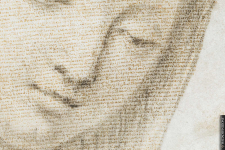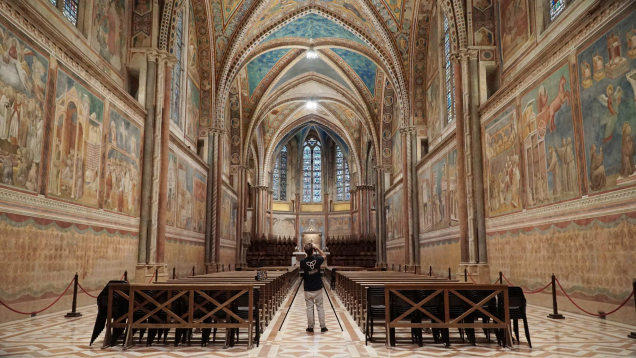
There are details that can easily be missed during a visit: a brushstroke, a face, a decoration placed too high to see clearly, a section of fresco that is difficult to observe up close. Preserving Assisi was created with this in mind too, offering the possibility of experiencing the Basilica of Saint Francis at different speeds, distances and viewpoints from those of a physical visit.
Presented on 16 September 2026, in the year marking the eighth centenary of the death of Saint Francis, the platform brings together in a single digital environment ultra-high-resolution gigapixel images, virtual tours, 360° panoramas, three-dimensional surveys and a digital archive. The project is led by Haltadefinizione and the General Custody of the Sacred Convent of Saint Francis of the Conventual Friars Minor.

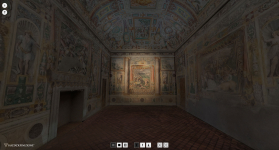
The platform allows visitors to move virtually through the spaces of the complex and explore its painted cycles, moving from an overall view of the architecture to a close-up examination of individual works.
The gigapixel images make it possible to zoom into surfaces and details with a level of precision that is difficult to achieve during a normal visit, while the 360° environments reveal the relationship between artworks, architecture and space.
The digital experience is not intended to replace a visit to the Basilica. Rather, it offers a different level of access and understanding, allowing visitors to return to the works, focus on individual details and observe elements that are normally difficult to reach.

Almost 8 billion pixels in a single image
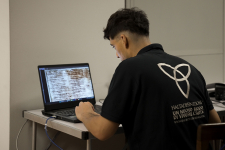
Behind what can be seen online lies extensive work in data acquisition and processing.
During the campaigns carried out between 2025 and 2026, more than 27,000 photographs were taken, generating over 12 TB of data and 98 final digital assets, including gigapixel images and 360° panoramas.
Among the most significant results is the new gigapixel image of Pietro Lorenzetti’s Crucifixion, in the south transept of the Lower Basilica. Created in July 2026, it measures 101,627 × 78,170 pixels and contains almost 8 billion pixels.
These figures become meaningful when you begin exploring the image: zooming into the work reveals pictorial details, surfaces and traces that can easily go unnoticed from a distance.
Preserving Assisi is not simply a tool for exploration. The images and surveys produced during the campaigns record the condition of the Basilica at a specific point in time and provide documentation that can be used over time for study, monitoring, conservation and restoration.
This is one of the project’s central aspects: what today allows the public to approach a fresco virtually may, in the future, also become a reference for comparison for scholars and conservators.

A story that began before the digital age
This approach to documentation has much earlier roots. In the 1990s, for the Mirabilia Italiae series, Franco Cosimo Panini Editore carried out an extensive photographic campaign documenting the Basilica. Following the 1997 earthquake, those images acquired a significance that went far beyond the publishing project for which they had originally been created, becoming an essential reference for the reassembly and restoration of the damaged frescoes.
In 2009, Haltadefinizione returned to Assisi with a technology that was still new to the cultural heritage sector at the time: gigapixel imaging. The 28 scenes from the Stories of Saint Francis in the Upper Basilica were digitised in ultra-high resolution, opening up new possibilities for observing and studying the painted cycle.
Today, Preserving Assisi brings this history together and takes it further, connecting images, spaces, surveys and data within a single digital environment.
Digitisation campaigns will continue, with new spaces, artworks and content progressively added to the platform, expanding the digital documentation of the Basilica complex over time.