Every sheet of the Codex Atlanticus, the great corpus of writings and drawings by Leonardo da Vinci preserved at the Veneranda Biblioteca Ambrosiana in Milan, contains hidden information within the paper itself.
Watermarks, in particular, are small designs or marks created during the paper-making process, through a thinner deposit of fibres corresponding to the design. Often difficult to observe with the naked eye, they are an essential tool for reconstructing the provenance of the sheets, their material history and the relationships between documents now preserved in different collections.
This is the aspect on which Haltadefinizione focused its contribution to the new Leonardo//thek@ 2.0, the digital platform developed by Museo Galileo - Istituto e Museo di Storia della Scienza di Firenze and dedicated to the manuscript heritage of Leonardo da Vinci.
The platform now enables integrated access to the Codex Atlanticus, preserved at the Biblioteca Ambrosiana, together with the archive of around 600 Leonardo sheets from the Royal Collection Trust in Windsor. This is a project of major scientific importance, digitally bringing together materials that have been separated for more than four centuries and making them accessible through images, transcriptions, critical apparatus, thematic indexes, research tools and data on the material characteristics of the sheets.

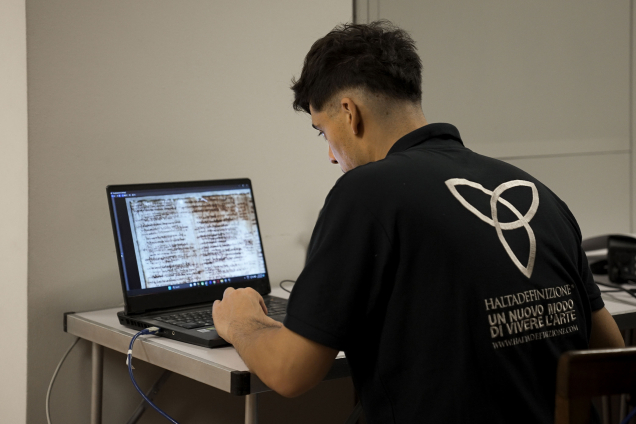
As part of the project, Haltadefinizione was responsible for digitising the 1119 sheets with watermarks of Leonardo’s Codex preserved in Milan. The aim was to make legible elements that are often invisible, fragmentary or obscured by the presence of texts, drawings, inks and variations in the support.
The work required a preliminary analysis phase, necessary to identify the acquisition techniques best suited to the specific condition of each sheet. The thickness of the paper, the density of the inks, the presence of drawings, the state of conservation and the characteristics of the fibres all affect the visibility of the watermarks and require differentiated approaches.
The acquisitions were carried out at 800 ppi, combining several ultra-high-resolution imaging techniques: transillumination, near-infrared reflectography and raking light photography.
Transillumination, or transmitted light, makes it possible to illuminate the sheet from the side opposite the observation point. This reveals variations in the thickness of the paper: the thinner areas corresponding to the watermark react differently as light passes through them and can therefore be identified with greater precision.
Near-infrared reflectography was used in cases where texts, inks or drawings made the watermark more difficult to read. At certain wavelengths, some visual interferences are reduced, making it possible to distinguish details that would otherwise be difficult to isolate within the material structure of the sheet.

Raking light photography, on the other hand, made it possible to observe the surface of the paper, highlighting reliefs, incisions, deformations and physical traces linked to the production, conservation and use of the sheets.
Ultra-high resolution makes it possible to analyse the material structure of the paper with a level of detail suitable for scientific consultation. Minimal variations in the grain of the support, almost imperceptible marks and traces that are not immediately visible can be enlarged and studied remotely, without subjecting the originals to further handling.
The digitisation of the watermarks thus enriches the study opportunities offered by Leonardo//thek@ 2.0. Alongside the reading of Leonardo’s texts and drawings, it provides a deeper understanding of the material support: the paper itself becomes a document, a source of information on the history of the sheets, their provenance and the relationships between the different parts of the Leonardo corpus.
The project is the result of a collaboration between Museo Galileo, the Veneranda Biblioteca Ambrosiana, the Royal Collection Trust in Windsor and the Biblioteca Leonardiana di Vinci, with the contribution of the Commissione per l’Edizione Nazionale dei Manoscritti e dei Disegni di Leonardo da Vinci.